

The International Longshore and Warehouse Union announced August 4th, that members voted 67% in favor of extending their contract by three years to July 1, 2022. Both port management and workers expect the agreement to boost traffic and return lost market share to the West Coast. This news has inspired speculation on the International Longshoremen’s Association and the East Coast management organization, United States Maritime Alliance, as they enter talks about an extension of their own contract, which expires on Sept. 30, 2018. Since 2005 ports on the West Coast ports have lost 12% market share, from 79% to 67 %, for US imports from Asia due to the proliferation of distribution centers and warehousing near East and Gulf Coast. Also pertinent, the labor disruption of 2014 that saw West Coast ports crippled as cargo was diverted to the East Coast and Gulf ports to avoid the work stoppage. With the Panama Canal expansion completed, new dredging and harbor infrastructure in the East and Gulf ports allowed them to accept new Post-Panamax megaships that recently had only found the West Coast acceptable. The expansion of the Port of Norfolk has been a local boon to the State of Virginia as the infrastructure repairs and deep water harbor allow us to welcome Post -Panamax ships and emboden our position as a natural export hub. By utilizing our expanding rail and inland port structure, we’re able to continue growing as the negotiations move alone on both coasts. The agreement was reached by avoiding discussions about automation and jurisdiction, topics that can cause deep disagreements and tense negotiations. By focusing on benefits, wages and pensions, the parties were able to come to a mutual agreement on basic issues while ensuring work would remain consistent. As the market reacts adversely to delays and rerouting that happens when negotiations break down, the agreement comes is a welcome site. We at Nelson International watch these discussions closely to ensure your cargo is always booked and scheduled for the fasted available routing. When and if there were more delays arising, we’re prepared with alternate options for our clients to minimize the impact that this has on your business. We look forward to talking more about this issue as the East Coast ports begin negotiations and will continue to follow any news that affects our industry here in our blog.

Mergers and Strategic Partnerships
Once the $6.3bn agreement to buy OOCL is approved, Cosco will become the third largest container line in the world. The agreement, announced July 9th, is the latest in a string of consolidations that will see 75% of all container ships in use controlled by the top seven companies. One key factor in Cosco’s interest is the OOCL carrier rating and management practices. As one of the most efficient carriers with a decidedly global awareness it will behoove Cosco to maintain the brand and spend the promised two years working to adopt and incorporate the highlights of the OOCL model into the Cosco practices. Mergers and acquisitions have been swarming the logistics news pipeline for well over a year as restructuring and low rates force companies to come together and support each other, whether it’s by merging or building strategic partnerships. Interestingly, one of the highlights of a strong freight forwarder is their emphasis on building a strategic network of partnerships with carriers and agents overseas to expand their network of service and add value to the shipments by leveraging those partnerships. Nelson International has worked diligently to create the same strategic partnerships so our customers know they can move freight on any carrier, to any port. The longevity of our partnerships is paramount when considering new business opportunities in new places. Our customers understand that we have tried and true unity among our overseas partnerships that work with all carriers to secure the best rates and fastest shipping times. By focusing on market changes and watching the mergers that are happening, we have a plan in place before issues arise that can cost our clients time or money. As more carriers come together, we continue to watch for hidden opportunities to negotiate into stronger buying positions for our customers. And we watch for hidden pitfalls that can cause grief that stems from any reduction in transportation options. Your cargo is safely moved through our tried and true channels to be handed off to only our most trusted allies, while your rates are further protected and ensured by our attention to the market conditions. If you have questions about how Nelson International can help you navigate through the myriad of changes happening, give our customer service team a call. We are on hand to ship your cargo and to explain and advise on all issues currently facing shippers. We look forward to hearing from and working with you during this time.

Port of Norfolk breaks more records and receives awards!
The Port of Virginia is all over the news this month with accolades and record breaking numbers. Nelson International is proud to call this our home port and applaud the hard work and dedication that goes into such a large part of our state infrastructure. In addition to posting the fourth straight year of growth, the port received 10 awards for the AAPA’s annual communications awards and opened a new 26-lane, state of the art PRO-PASS North Gate Complex at the Norfolk International Terminal. With the news of how well the port is performing, we can look to the NRF’s statement on imports rising and see how Virginia stacks up with other ports to reach record highs for July and August. The Port of Virginia announced its annual container volume on July 11, 2017 as 2.7 million TEU, breaking their current record for volume and making last year the fourth consecutive fiscal year of growth. “The Port of Virginia team and its labor partners accomplished a lot in fiscal year 2017,” said port CEO and executive director John F. Reinhart. “We grew in the right areas, we moved a record-amount of volume across all modes of transportation . . . and we continue to improve our service levels. The $670 million we are investing to expand the capabilities and capacity at The Port of Virginia are aimed at sustaining this trend into the next several decades.” The investments in capacity include $320 million to double container capacity at VIG, another $350 million to renovate the south container yard at NIT, and $42 million to build the new 26-lane NIT gate. With confirmed federal approval for the East Coast Gateway Terminal Agreement that includes the Georgia Ports Authority, new stacking cranes and the arrival of the 13,000TEU Costco Development, we expect next year to hold even more record-breaking months in a record-breaking year. The National Retail Federation (NRF) and Hackett Associates have reported that 1.72 million TEUs were handled in May, a 7.3% rise from April and 6.2%YOY. This report further estimates these ports handled approximately 1.66 million TEUs in June, a 5.3% YOY increase. Along with the Port of Virginia, The Port of Long Beach, Port of Oakland, and The South Carolina Ports Authority all posed yearly increases in volume for May of 2017. Their report leads them to forecast record high levels of import containers for July and August as school supplies continue to flood in for the back to school season. In addition to the record breaking numbers flowing through the Port of Virginia, the terminal received 10 awards from the American Association of Port Authorities (AAPA) this year for the ten projects submitted in the trade group’s annual communications awards. Awards were based on a mix of effectiveness, research, clarity and creativity. The six winners of Awards of Distinction and the four Awards of Merit will be honored in October at the 106th Annual Convention and Expo. We at Nelson international could not be prouder of our affiliation with the Port of Virginia and look forward to talking more about their successes in the future. To find out how the Port of Virginia can figure into your logistics needs, contact our staff!
Container import figures show expected slowing but still predict a record-breaking summer
Slowing import growth at container ports started in April though the total volume of containers handled should hit an all-time high by the end of the summer. Forecasts estimate that while summer numbers will continue to grow month over month, few reports will show a jump on par with what we saw from February to March of this year. Attributed to a decrease in China’s industrial output, the numbers aren’t unexpected or worrisome for analysts as the industry put up some huge numbers early in the year, leading to an expected slowdown. Ports handled roughly 1.61 million TEUs in April, an increase of 4.8% in March (11.3% over March 2016) though details for March numbers showed ports handling 1.53 million TEUs, which was a 6.8% spike over February 2017 and a mammoth leap of 15.8% above the March 2016 figures. According to the monthly Global Port Tracker report by the National Retail Federation (NRF) and Hackett Associates, “Year-over-year comparisons are slowing down, but that’s largely because we had some unusual numbers early this year and strong volume in the second half of last year. Despite that, we’re expecting some of the largest import volumes we’ve ever seen, and that’s because retailers are responding to strong consumer demand.” Strong consumer demand doesn’t show any signs of slowing throughout the summer and well into the fall. Report forecasting each month year-over-year expect: • May – 1.69 million TEUs, an increase of 3.9% • June – 1.64 million TEUs, an increase of 4.1% • July – 1.68 million TEUs, an increase of 3.5% • Aug – 1.74 million TEUs, an increase of 1.6% • Sept – 1.64 million TEUs, an increase of 2.8% • Oct – 1.69 million TEUs, an increase of 1.3% Included in the above research estimations are the U.S. ports of Los Angeles, Long Beach, Oakland, Seattle, Tacoma, New York/New Jersey, Hampton Roads, Charleston, Savannah, Port Everglades, Miami, and Houston.
Port of Norfolk dominates again.
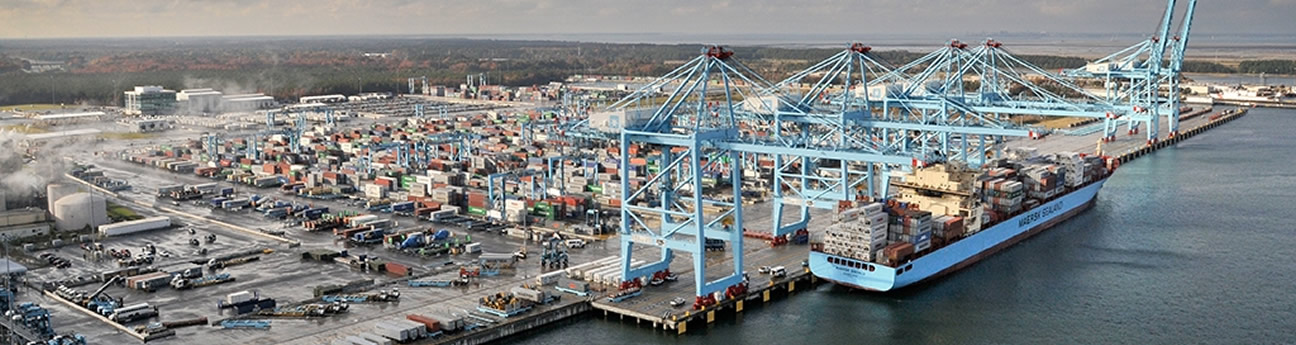
As the three new alliances began calling US ports in April, there have been few operational delays and setbacks. Minor inconveniences such as ships arriving off schedule for new routings were expected, but nothing to indicate concerns among ports. BlueWater Reportings data advised that the Port of Norfolk is the top US East Coast Port for transpacific Asia-US alliance services as a total of 61,434TEUs were serviced per week. Announced after the arrival of the COSCO Development[1], reports of a 4.6% rise in box volumes for April the Port of Norfolk expects to finish this fiscal year, ending June 30th, with a 7% year-over-year increase. Port of Virginia terminals handled 225,196 TEUs in April 2017, with loaded export containers up 4% and import containers 9.4% from April 2016, according to monthly reports provided by the Virginia Ports Authority. We expect these numbers to positively impact the discussions going forward regarding the burgeoning alliance between the Ports of Norfolk and Savannah to become the East Coast Ports Alliance. Though both sides are still waiting to hear if they’ll get the FMC approval they need to move forward. The plan is to continue operating as separate entities, while sharing some information such as equipment purchasing decisions and preferred market targets which would allow these ports to complement and supplement each other by specializing in different cargo, rather than competing in a market of tight margins. Apart from the perspective alliance, the two ports aren’t holding off on their current race to be the dominant East Coast Port in the US. Both are moving toward being dredged even deeper to accommodate more draft height and thus more containers. The Port of Norfolk looks to go from 50-55 feet as the COSCO Development couldn’t dock with a fill load of cargo because the channel only supports a 45-foot draft, with five feet of clearance. With a 55-foot channel ships like the Development visit fully loaded at any time of day without regard for tidal impact. The Port of Savannah looks to dredge to theit full 52-foot permit depth. Each foot of draft represents $10-$15 million in cargo on a ship the size of the COSCO Development, a concern for Port of Savannah. The difference in their dredges represents $30-$45 million in cargo. [1] The 13,092-TEU COSCO Development is the largest ship to transit the newly-expanded Panama Canal and called the U.S. East Coast, called the Virginia International Gateway terminal in Portsmouth on May 8.
Automation comes to container ships.
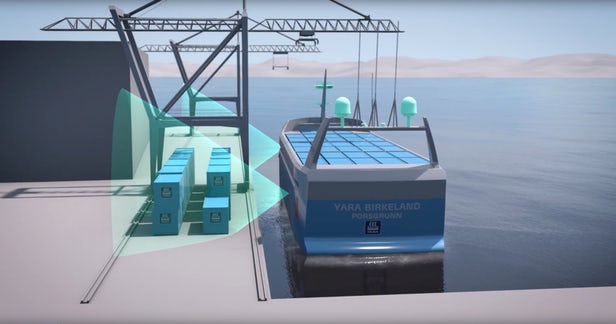
The world’s first fully electric container vessel, YARA Birkeland, will begin making manned voyages from the YARA production plant in Porsgrunn, Norway to Brevik and Larvik in 2018. The vessel is expected to begin making remote operated trips in 2019, finally becoming fully autonomous in 2020. Expected to reduce CO2 emissions by removing 40,000 trucks from the route connecting these cities, YARA Birkeland is a paradigm shift in an industry fraught with discussion on sustainability. “As a leading global fertilizer company with a mission to feed the world and protect the planet, investing in this zero emission vessel to transport our crop nutrition solutions fits our strategy well. We are proud to work with KONGSBERG to realize the world’s first autonomous, all-electric vessel to enter commercial operation,” says Svein Tore Holsether, President and CEO of YARA. “Every day, more than 100 diesel truck journeys are needed to transport products from YARA’s Porsgrunn plant to ports in Brevik and Larvik where we ship products to customers around the world. With this new autonomous battery-driven container vessel we move transport from road to sea and thereby reduce noise and dust emissions, improve the safety of local roads, and reduce NOx and CO2 emissions,” says Holsether. KONGSBERG developed the technologies enabling the complete automation of the YARA Birkeland including the sensors, electric drive, battery and propulsion control systems. The hope is that not only does the electric automation alleviate the environmental impact of container shipping, but that it can decrease road wear and traffic congestion as it shifts transportation from roads to seaways. “By moving container transport from land to sea, YARA Birkeland is the start of a major contribution to fulfilling national and international environmental impact goals. The new concept is also a giant step forward towards increased seaborne transportation in general,” says Geir Håøy, President and CEO of KONGSBERG. It’s another step toward fully automating our seaways, though completely unmanned ocean transport is still quite a while down the road. The obvious regulatory, safety and environmental hurdles will need thorough review and preparation, but we at Nelson International are excited about the prospect of one day, maybe sooner than we originally expected, welcoming the first fully automated, unmanned container ship here at the Port of Virginia.
Port of Virginia sees 4th busiest month and prepares for 13,000 TEU vessel
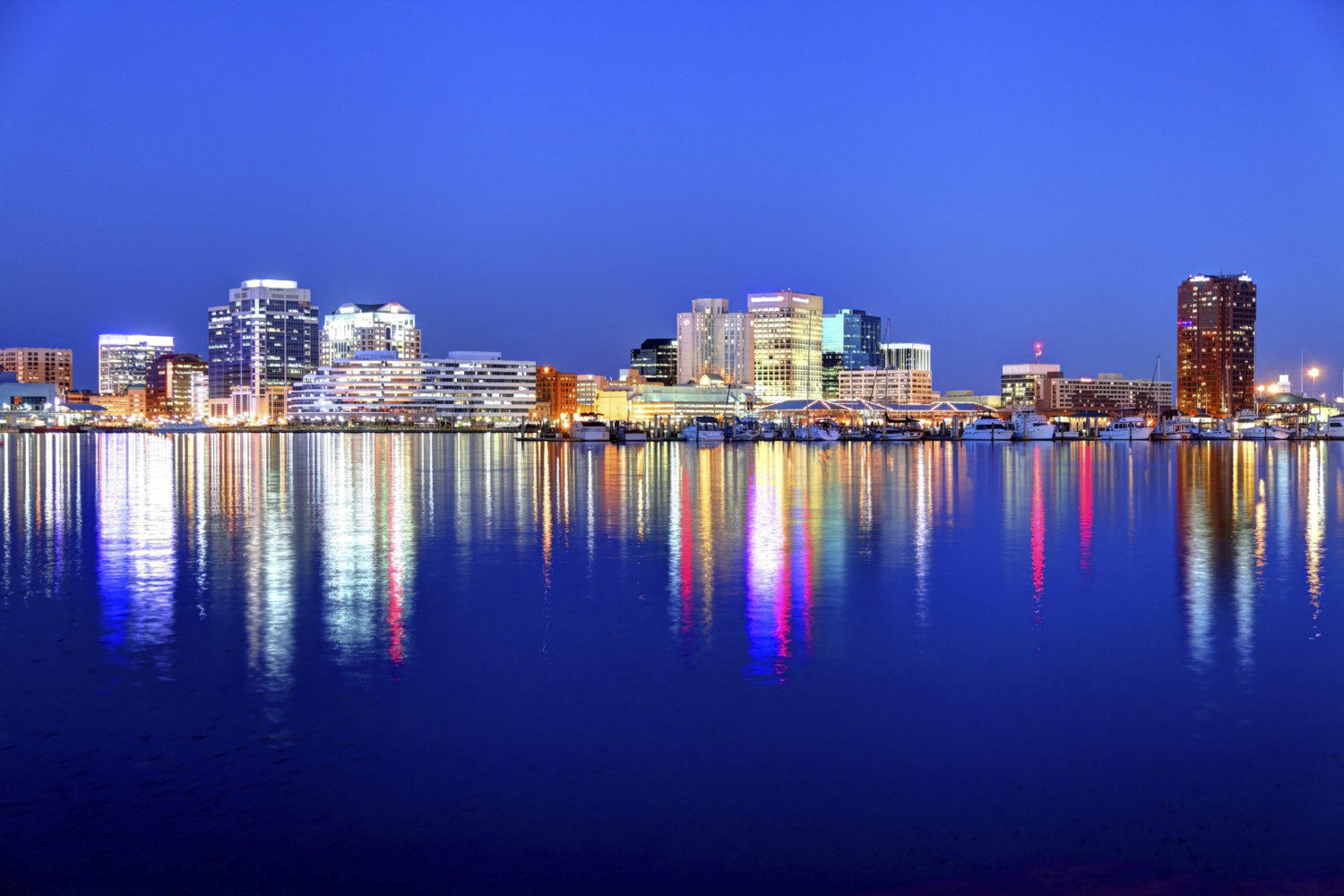
In another successful month, the Port of Virginia shows a 9% increase over March 2016 in container volumes for March 2017 as they moved 232,148 TEUs in preparation for the arrival of the COSCO Development – a 13,000 TEU ship that expects to move 4,000 containers. As this is the port’s 4th best month, there is little doubt that the Port of Virginia will be able to handle super-sized vessels. On May 8th, 2017 the COSCO Development will arrive at the Port of Virginia, which is the first stop on the East Coast after navigating the newly expanded Panama Canal. After more than a year of infrastructure improvements, including an initial dredge of the harbor to a depth of 50 feet that is expected to eventually reach 55 feet. It’s the only port on the East Coast with Congressional approval to reach that depth. In hopes of being able to host the new mega-ships, a $350m infrastructure program was started last year to upgrade and expand after traffic congestion in 2015 almost shut down the port. The expansion has re-energized the port, which has consistently showed month over month growth in volume and productivity, culminating in the port becoming profitable in 2016 for the first time in seven years. “March was the fourth busiest month in our history and our growth was 9 percent when compared with last March,” said John F. Reinhart, CEO and executive director of the Virginia Port Authority. “We are expecting volume to remain in positive territory as we move into spring and look forward to peak season. The new ocean-carrier alliances will be fully operational this month (April) and we will be seeing more big ships, like the COSCO Development, moving considerable amounts of cargo. As these ships arrive, planning and preparation are going to be paramount to our efficiency.” March Cargo Snapshot Loaded Export TEUs – 92,384 up 3% Loaded Import TEUs – 99,665 up 9.5% Containers – 131,800, up 9% Rail Containers – 48,206, up 3% Barge Containers – up 4,249, up 30% Truck Containers – 79,345, up 12% Richmond Marine Terminal Containers – 2,027, down 2%
Shipping alliances may spur new laws for trade
According to an article in the Wall Street Journal, the US Justice Department raid on the Box Club meeting in late March was due to suspected collusion against tug boat operators by global shipping alliances. The increased attention on alliances is pushing Congress to get involved and revisit the Shipping Act of 1984 which was amended in 1998 to allow contract confidentiality between shippers and carriers. With the three massive alliances in play as of this year, regulations on how they will set prices, negotiate and manage their contracts are of paramount importance to ports, terminals and dock workers and the joint-contracting that shipping alliances are allowed or not allowed to do. The number of major carriers has fallen from 20 to 17 in the last few years and will go to 13 in 2018, if planned mergers go forward, no more are announced, and none become the next Hanjin Shipping by collapsing. Representatives of both sides are set to testify at a Congressional subcommittee hearing in May regarding the new rules and regulations that will need to be in place to protect both sides from collusion, price fixing and the protection of private information between the allied parties. While almost all alliance agreements include joint-contracting language, it has been removed due to antitrust laws before the agreements are filed. Once the mergers are complete, companies can operate as a single entity; in the months leading up to the merger, they are legally unable to negotiate as a whole single party. “This provision, if allowed to remain in the agreement, could adversely affect AWO member companies and other American businesses, seriously degrade competitive conditions in US ports and harbors, and encourage other groups of foreign carriers to follow suit,” said American Waterways Operators (AWO) president and CEO, Thomas Allegretti. As discussed in our previous topic, the Virginia Port Authority is filing the East Coast Port Agreement with the FMC alongside the Georgia Port Authority to increase efficiency and communication and enhance cooperation to compete with the larger U.S. ports. The outcome of reevaluating the Shipping Act of 1984 is crucial to moving forward for both shipping alliances and the ports, staff, and stevedores that support international trade. Alliances offer protection to shipping lines that have been suffering from deep profit losses while giving port alliances power to negotiate under a broader umbrella, enhancing their position in a negotiation, especially for smaller and mid-size ports like the Port of Norfolk. Alliances also offer options to shippers whether they need strategic lanes for minimizing transit time or avoiding costly delays at overbooked ports. While we aren’t sure how or even if Congress will revisit the current laws in light of the new shipping alliances and subpoenas handed out at the Box Club meeting in March, the mergers of 2017 are sure to be instrumental in how shippers move cargo in the future.
Ports of Virginia and Georgia to create East Coast Gateway Terminal Agreement
In a combined effort to encourage cooperation, communication, and efficiency in regards to operations, safety and customer service, Georgia Ports Authority and the Virginia Port Authority filed a request with the Federal Maritime Commission to create the East Coast Gateway Terminal Agreement on Friday, February 24th. The agreement is expected to enable the ports as a whole to create workable solutions together which mutually benefit the states and alliance as a whole. While Georgia and Virginia aren’t the first terminals to begin sharing information (In December 2016, APM Terminals, DP World, Hutchinson Port Holdings, PSA International, Shanghai International Port (Group) Co., and the Port of Rotterdam Authority filed the “Global Ports Group Agreement” with the Federal Maritime Commission to promote the efficiency and effectiveness of the container port industry), the processes and outcomes are still in their infancy. The hope is that by combining the mutual interest of the ports and promotion greater options to shippers and carriers, all locations will find increased market share, especially against the bigger ports of New York/New Jersey. Combined capital will enhance infrastructure and training as member ports share tools and information between them. The union will combine the collective benefits and offer new options for solving complex issues that today’s ports are facing. We at Nelson International are excited for the myriad opportunities that are coming available and will be here to discuss any concerns or ideas that may come from this announcement.
Synopsis of the ILA / USMX negotiation
On Tuesday, a press release from the ILA called for a shutdown of ports along the Atlantic and Gulf Coasts to protest job losses and highlight hiring practices that purposely reduce the numbers of dockworkers, causing immeasurable damage to the nation’s economy. The ILA also states that the Waterfront Commission, which helps regulate the labor supply, is “damaging the regional economy of the Port of New York and New Jersey” by “causing hundreds of jobs at the port to remain unfilled.” The press release also stated “interference by the South Carolina Port Authority has reduced the number of dockworkers, injuring not only the port itself, but also the local and national economy.” On Wednesday the United States Maritime Alliance (USMX) responded with a statement, “The master contract between the ILA and the USMX forbids any unilateral work stoppage by the ILA for any reason. If the ILA engages in any unilateral walkout, USMX will enforce the contractual rights of its members to the fullest. USMX urges the ILA to remain in compliance with the master contract and thus continue to provide the stable labor environment that has existed on the Atlantic and Gulf coasts for decades.” Further comments have continued to come in and include those of Peter Friedmann, executive director of the Agriculture Transportation Coalition (AgTC), in a letter to Secretary of Transportation Elaine Chao, “on behalf of U.S. agriculture, forest products and commodities exporters, we ask that you bring your experience and office to bear to prevent such a shutdown, and to protect the economy from injury that in some cases will be irreversible. Unfortunately, we have ample and recent experience as to the impact of the shutdown of operations of marine terminals. Another shutdown of our ports would again undermine our reputation as dependable suppliers.” “Our exports constantly face the challenge of foreign competition,” Friedmann added. “There is nothing that we export in agriculture, forest products and many commodities, that cannot be sourced somewhere else in the world. If we do not deliver efficiently, affordably and dependably, our foreign customers have demonstrated that they can and will find another source in another country.” With a shutdown threatening, shippers are concerned at the possibility of delays. The last shut down by the ILA is estimated to have cost the U.S. economy approximately $1.9 billion per day. Peter Friedmann explained that for every day a terminal is down, it will take a minimum of six days to recover. This morning, ILA President Harold Daggett has expressly urged union members to avoid work stoppage until the ILA has met with Congress to express their concerns. Informal talks on February 15th in Delray Beach, FL between the ILA and USMX were called “productive and fruitful” in a joint statement. Nelson International is closely watching as this unfolds and will continue to bring you updates as more information becomes available.
